



Best Tagging Practice
Draft: this text waits for the owner's approval.
Four basic steps
Use the applicator made for your tag type, and check that it works before you start.
- Place each part of the tag, male and female, in its position on the applicator.
- Make sure the animal is held as still as possible.
- Dip the tag, in the applicator, in disinfectant.
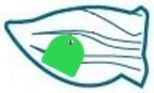
- Check that the two parts of the tag line up. Always pass the male part from the back of the ear: the length of the applicator guides you to the right depth, between the ribs of the ear. Press, and you’re done.
Why placement matters
However well a tag is made, correct marking depends on where and how it is applied. If an animal isn’t kept still during vaccination, the needle bends and, after a few uses, can break and stay in the tissue. The same is true of ear tags.
With every type of ear tag, the first conditions for a good application are a still animal and the right piercing point. When a tag is under strain, from the animal’s movement, from hard tissue, or from both, the pressure on it rises sharply, and that can cause damage you don’t see at once:
- Solid pins. With this type of tag, the animal’s movement and hard tissue can bend the pin under the high pressure and damage the male part before the tag is fully in.
- Hollow pins. Found on many ear tags. The applicator’s support spike lets a hollow-pin tag go in even through hard tissue and while the animal moves, but the higher pressure can deform the pin’s thin walls. In time the head of the pin may come off and the tag be lost, even when no strain was visible.
Reducing the strain
Don’t apply a tag close to the base of the ear: let the length of the applicator guide you to a safe point with soft tissue. Placing tags at the edge of the ear can also lead to lost tags and torn ears.
Conditions by species
To apply each Rigidtag™ type well on each kind of animal, make sure of the conditions in this table.
| Animals | Age | Condition | Note |
|---|---|---|---|
| Young sows and boars | 4–6 months | In heat | Keep the animal completely still |
| Adult sows | — | Choose soft tissue | In heat, kept still |
| Cattle | Young and adult | Choose soft tissue | Keep the animal completely still |
| Adult sheep and goats | — | Choose soft tissue | Keep the animal completely still |
| Companion animals | Young and adult | Choose soft tissue | Keep the animal completely still |
| Wild animals | Young and adult | Choose soft tissue | Keep the animal completely still |
Choose the tag
- Goliath Rigidtag™ is the large tag: its print is designed to be read from a distance, without catching the animal. Use it to mark sows.
- Jumbo Rigidtag™ is the medium tag, with room for more information and more complex print layouts. Use it for piglets (gilts and boars), and wherever a medium tag suits.
Every Rigidtag™ is a pair, a male and a female part, for single use.
When to tag pigs
- Young sows (Goliath): fit the sow’s definitive identification in young gilts at about six months of age, between the first and the second heat, in both ears.
- Older sows (Goliath): choose a day when the animal can be kept as still as possible, such as the mating day, and a point with soft tissue.
- Piglets (Jumbo): from 15 days of age.
Official marking
For official marking, the requirements differ by country and sector. Ask us what applies to you.